

Yes, you can retire at 60 with $500,000 in super in Australia. It is not a huge balance, but it is enough to fund a modest to moderate retirement if you own your home and manage the seven-year gap before the Age Pension starts at 67. $500K sits below the ASFA comfortable benchmark but well above the modest target, which means your lifestyle will land somewhere in between, depending on how you spend and invest.
The retirement age in Australia is often misunderstood. There is no official “retirement age” that forces you to stop working. Your preservation age (60 for anyone born after 1 July 1964) is when you can access super tax-free, and the Age Pension eligibility age is 67. Everything between those two numbers is a planning decision, and with $500,000, it is a decision worth getting right.
How long will $500K super last in retirement?
This is the first question most people ask, and the answer depends on how much you spend each year.
Please note: All figures, projections and scenarios in this article are approximate and for illustrative purposes only. They assume a balanced investment return of approximately 5% per annum after fees. Individual outcomes will vary based on personal circumstances, investment returns, fees and current government policy. This is general information, not personal advice.
| Annual spending | How long $500K lasts | Age super runs out |
|---|---|---|
| $30,000/year | 22 to 27 years | Early to late 80s |
| $40,000/year | 15 to 18 years | Mid to late 70s |
| $50,000/year | 11 to 14 years | Early to mid 70s |
These figures assume you draw from super only, with no Age Pension until 67. Once the pension starts, your required drawdown drops and the remaining balance stretches much further.
The takeaway: at $35,000 to $40,000 a year, $500K can comfortably bridge you through to the Age Pension with a healthy buffer left over.
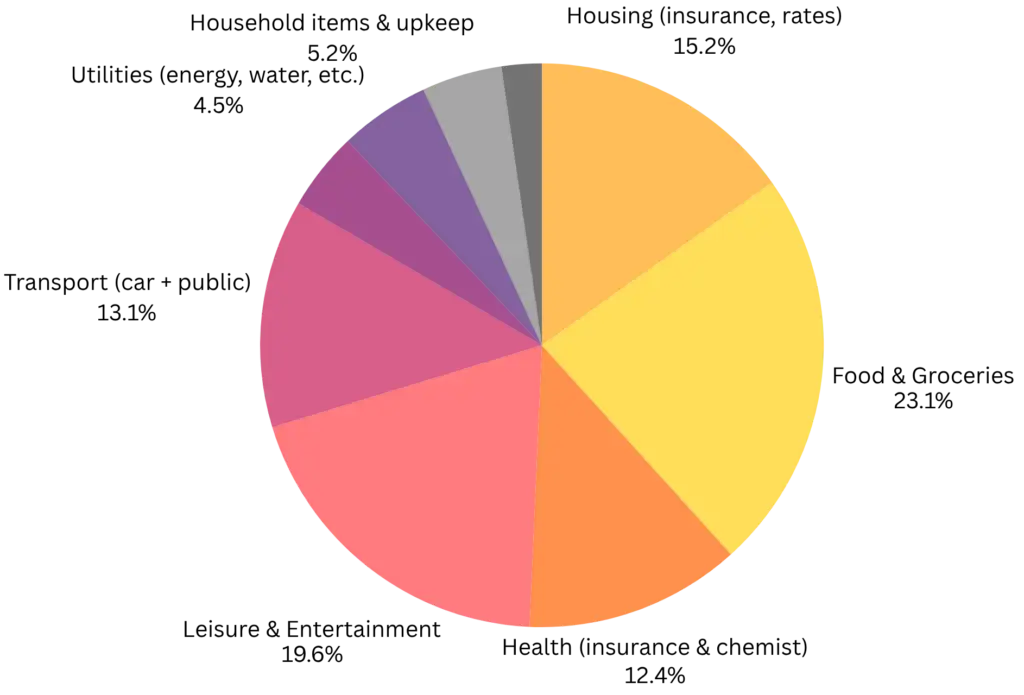
How $500K compares to the benchmarks
The ASFA Retirement Standard (lump sums updated February 2026, spending figures updated quarterly) sets the recommended lump sums for homeowners retiring at 67 at $630,000 for a comfortable single retirement and $730,000 for a couple. For a modest retirement, you need just $110,000 (single) or $120,000 (couple) because the Age Pension covers most of the spending at that level.
$500,000 sits between those benchmarks. You have well more than enough for a modest retirement but you are $130,000 short of the comfortable single target and $230,000 short of the couple target.
Those ASFA figures assume you retire at 67, not 60. Retiring seven years earlier means your super needs to fund those extra years before the Age Pension kicks in. So while $500K is a solid balance, the gap years are where careful planning matters most.
For context, the average super balance for Australians aged 60 to 64 is approximately $381,000 for men and $301,000 for women, based on ASFA’s analysis of ATO data. With $500,000, you are above average for both, which puts you in a stronger position than most.
Scott and Phil covered the real cost of the gap years in Episode 19 of the podcast, including how retiring even one year earlier can dramatically change how long your money lasts.
The 60 to 67 gap: seven years you need to fund yourself
This is the planning window that makes or breaks a $500K retirement. From 60 you can access super tax-free. But the Age Pension does not start until 67, and that is seven years where your super has to cover everything.
At $40,000 a year in spending, you would draw down roughly $280,000 over those seven years (allowing for some investment growth on the remaining balance). That leaves you with somewhere around $250,000 to $280,000 at age 67.
From 20 March 2026, the full Age Pension pays $1,200.90 per fortnight for singles ($31,223 a year) and $1,810.40 per fortnight for couples combined ($47,070 a year). A single homeowner with assessable assets under $321,500 qualifies for the full pension. For homeowner couples, the full pension threshold is $481,500 (current as at 20 March 2026).
Source: Services Australia. These figures are set by the Australian Government and are updated each March and September.
If you arrive at 67 with $250,000 in super, you qualify for the full Age Pension as a single homeowner or a substantial part pension as a couple. From that point, your remaining super just tops up the pension payment, and $250K can last well into your late 80s or beyond when it only needs to cover the gap between the pension and your actual spending.
Phil and Dan walked through real worked examples of how the assets test and income test interact in Episode 10 of the podcast. They also covered commonly missed Age Pension opportunities in Episode 20.
The cost of being single in Australia: how $500K plays out differently
This is one of the most under-discussed aspects of retirement planning in Australia, and the data from Google shows that many people are searching for it. The cost of being single in Australia is significantly higher per person than being part of a couple, and it affects how far $500K stretches in retirement.
A single person pays the full cost of housing, utilities, car registration, insurance and council rates on one income. A couple shares those fixed costs across two people. ASFA’s numbers show this clearly: a comfortable retirement for a single person requires $54,840 a year in spending, while a couple needs $77,375. That’s not double it’s only about 41% more for two people. The per-person cost for a couple is roughly $38,700, compared to $54,840 for a single. Being single in retirement costs about 42% more per person.
What this means for $500K: a single homeowner at 60 needs their $500K to work harder per dollar than a couple with the same balance. The Age Pension partially offsets this (the single rate covers a higher percentage of single-person costs than the couple rate covers of couple costs), but the core maths remain fixed costs don’t halve just because you’re alone.
For single women in particular, the super gap compounds this. The average super for women aged 60 to 64 is approximately $301,000, which means a single woman reaching 60 with $500K is actually well above average and in a relatively strong position. But the cost of being single still means she needs to be more deliberate about spending and drawdown than a couple with the same balance.
If you’re a single person planning retirement on $500K, the practical implications are: keep gap-year spending to $30,000 to $35,000 rather than $40,000, prioritise home ownership above almost everything else, and understand that the full single Age Pension ($31,223 a year) will be your primary income from 67, with super as a supplement.
Scott talked about why retirement planning hits women differently in Episode 17 of the podcast, including the super gap, longer life expectancy, and investment mix issues.
How Australian household cost increases affect your $500K
Australian household costs have been rising faster than general inflation for several years running, and this directly affects how far $500K goes in retirement. The Australian Bureau of Statistics data shows that essentials like electricity, health insurance, groceries and council rates have been increasing at rates well above the headline CPI figure.
For a retiree living on $35,000 to $40,000 a year, the impact is real. Your spending isn’t evenly distributed across the economy — it’s concentrated in exactly the categories that are rising fastest. Health insurance premiums alone have been increasing at 3 to 5% per year. Electricity and gas costs have spiked significantly. Groceries are up. Council rates keep climbing.
What this means for retirement planning with $500K: a projection that assumes 2.5% inflation may understate the real erosion of your purchasing power, because the basket of goods a retiree buys is weighted toward essentials that are inflating faster than average.
The practical response is threefold. First, keep some growth assets in your investment mix so your returns have a chance of outpacing real cost increases (more on this below). Second, build in a realistic healthcare cost allowance that grows over time, not a flat figure. Third, don’t assume the Age Pension will keep pace with your actual cost increases the pension is indexed, but the indexation formula doesn’t always match the cost pressures retirees face.
What’s the best way to invest $500K in Australia for retirement?
The best way to invest $500K in retirement comes down to three principles: keep growth in your portfolio, manage risk through the gap years, and don’t let fear push you into an all-cash position that quietly costs you tens of thousands.
Set up an account-based pension. Roll your super into an account-based pension rather than taking lump sums. This gives you regular, tax-free income from age 60, keeps your money invested, and helps you manage your drawdown rate. It is also treated more favourably under the Age Pension means test. For more on how this works, see our pension and Centrelink page.
Keep growth assets in your investment mix. A growth portfolio returning 6 to 7% per year can fund retirement into the late 90s, while a conservative portfolio at 3 to 4% runs out 15 years earlier on the same spending. A balanced approach, with around 60% in growth assets (shares and property) and 40% in defensive assets (bonds and cash), gives you the growth to outpace rising household costs while protecting against major market falls.
Scott and Phil discussed this in Episode 1 of the podcast, showing how a conservative portfolio can run out 15 years earlier than a growth one. Phil also pointed out in Episode 22 that what most super funds call “balanced” is really a growth portfolio with 70% or more in growth assets, so it’s worth checking what you’re actually invested in.
Hold a cash buffer of one to two years’ expenses. This protects you from sequencing risk. If markets drop 20% in your first year of retirement, you draw from cash instead of selling investments at a loss. Top up the buffer when markets recover.
Don’t chase returns with individual stocks or property. With $500K, you can’t afford a concentrated bet that goes wrong. Diversified index funds or a well-managed balanced option inside your super fund give you broad market exposure without the risk of one bad investment derailing your retirement. For more on superannuation investment options, see our service page.
How $500K plays out year by year
Here is a simplified projection for a single homeowner spending $38,000 a year, with a balanced investment return of 5% per annum:
| Age | Super balance (approx.) | Drawdown from super | Age Pension | Total income |
|---|---|---|---|---|
| 60 | $500,000 | $38,000 | $0 | $38,000 |
| 63 | $400,000 | $38,000 | $0 | $38,000 |
| 67 | $260,000 | $8,000 | $31,000 | $39,000 |
| 72 | $235,000 | $8,000 | $31,000 | $39,000 |
| 80 | $185,000 | $8,000 | $31,000 | $39,000 |
| 85 | $155,000 | $8,000 | $31,000 | $39,000 |
These numbers are approximate and assume steady returns (real life is bumpier). But the pattern is clear: your super does the heavy lifting from 60 to 67, and then the Age Pension takes over as the main income source.
Want to run your own numbers? Try the free Wealthlab super calculator to see how your balance, spending and Age Pension interact. For a broader readiness check, take the retirement quiz.
Five more strategies to make $500K last
Consider part-time work in the early years. Even $10,000 to $15,000 a year from casual or part-time work means that much less drawn from your super. Two to three years of light work can add significant years to your balance.
Keep spending under control in the gap years. The period from 60 to 67 is where your plan succeeds or fails. Aim for $35,000 to $40,000 a year and avoid large lump-sum withdrawals in the first couple of years.
Plan for the Age Pension from day one. Your retirement income strategy shouldn’t treat super and the pension as separate things. They work together, and the way you structure your drawdowns in the early years directly affects how much pension you receive at 67.
Budget for healthcare cost increases. A healthy 60-year-old doesn’t spend much on healthcare. By 75, specialist appointments, medications and procedures add up. Build in a realistic allowance that grows over time.
Get your Age Pension application in early. You can apply up to 13 weeks before you turn 67. Don’t leave it until after. Services Australia processing takes time and you don’t want to miss weeks of payments while waiting.
For more on structuring your retirement planning, see our service page.
Retirement age in Australia: what you actually need to know
A lot of the confusion around “retirement age in Australia” comes from mixing up three different ages.
Preservation age (60): This is when you can access your super tax-free, provided you meet a condition of release. For anyone born after 1 July 1964, preservation age is 60.
Age Pension age (67): This is when you become eligible for the government Age Pension, subject to means testing. It applies equally to men and women.
There is no compulsory retirement age. You can keep working as long as you want. The question is not “when am I allowed to retire?” but “when can I afford to?”
With $500K at 60, you can afford to retire, provided you plan the gap years carefully and are comfortable with a modest to moderate lifestyle.
Scott and Phil covered the common myths around retirement age in Episode 18 of the podcast, including the difference between preservation age and actual retirement, and why the 10-hours-per-week test matters for conditions of release.
Frequently asked questions
Can I retire at 60 with $500K in Australia?
Yes, if you own your home and are prepared for a modest to moderate lifestyle. $500K can bridge the seven-year gap to the Age Pension at 67 and, combined with the pension, support you well into your late 80s.
Is $500,000 in super enough to retire on?
For homeowners who budget carefully, yes. $500K is above the average super balance for Australians in their early 60s and well above the ASFA modest benchmark. It falls short of the comfortable target ($630K for singles, $730K for couples, as at February 2026), so your lifestyle will sit between modest and comfortable.
What is the best way to invest $500K in Australia for retirement?
For most retirees, an account-based pension with a balanced investment mix (about 60% growth, 40% defensive) is the most effective structure. It keeps your money invested and growing, provides tax-free income from age 60, and allows you to control your drawdown rate. Holding one to two years of expenses in cash protects against poor market timing. Avoid going all-cash, as this typically costs tens of thousands over a 25 to 30 year retirement due to inflation.
What is the cost of being single in retirement in Australia?
Significantly higher per person than being part of a couple. ASFA estimates a comfortable single retirement costs $54,840 a year, while a couple needs $77,375. That’s about 42% more per person for singles. Fixed costs like housing, utilities and insurance don’t halve just because you’re alone. The full single Age Pension ($31,223 a year) covers a reasonable share of modest costs, but single retirees need to be more deliberate about spending than couples on the same balance.
How do rising Australian household costs affect retirement?
Essential costs like health insurance, electricity, groceries and council rates have been rising faster than general inflation. For a retiree spending $35,000 to $40,000 a year, this means your real purchasing power may erode faster than standard inflation projections suggest. Keeping some growth assets in your investment mix and building in a healthcare cost allowance that increases over time are the main defences.
How long will $500K super last?
At $35,000 to $40,000 a year with balanced investment returns, $500K can last 15 to 22 years on its own. With the Age Pension from 67, your total retirement funding extends into your late 80s or beyond.
How much super should I have at 60?
The average is approximately $381,000 for men and $301,000 for women aged 60 to 64, based on ASFA’s analysis of ATO data. $500K puts you above average for both. Whether it is “enough” depends on your spending, home ownership and lifestyle expectations.
Will I get the Age Pension if I retire at 60 with $500K?
Not at 60. The Age Pension starts at 67. But by the time you reach 67, your remaining super balance will likely be low enough to qualify for a full or substantial part pension. A single homeowner with assets under $321,500 qualifies for the full pension (current as at March 2026). For couples, the threshold is $481,500.
How does renting affect retirement with $500K?
Renting adds $18,000 to $25,000 or more per year to your costs, which significantly compresses how far $500K stretches. The non-homeowner assets test threshold is higher ($579,500 for singles at March 2026), meaning renters may qualify for a larger pension, but ongoing rent costs still outweigh that advantage. If you’re renting with $500K at 60, working a few more years or finding a way to reduce housing costs before retirement makes a meaningful difference.
Your next step
$500,000 at 60 gives you a genuine path to retirement. The key is planning the gap years, keeping your investments working and understanding how the Age Pension changes everything from 67.
If any of this has raised questions about your own situation, book a free chat with the Wealthlab team. No pressure, no jargon.