
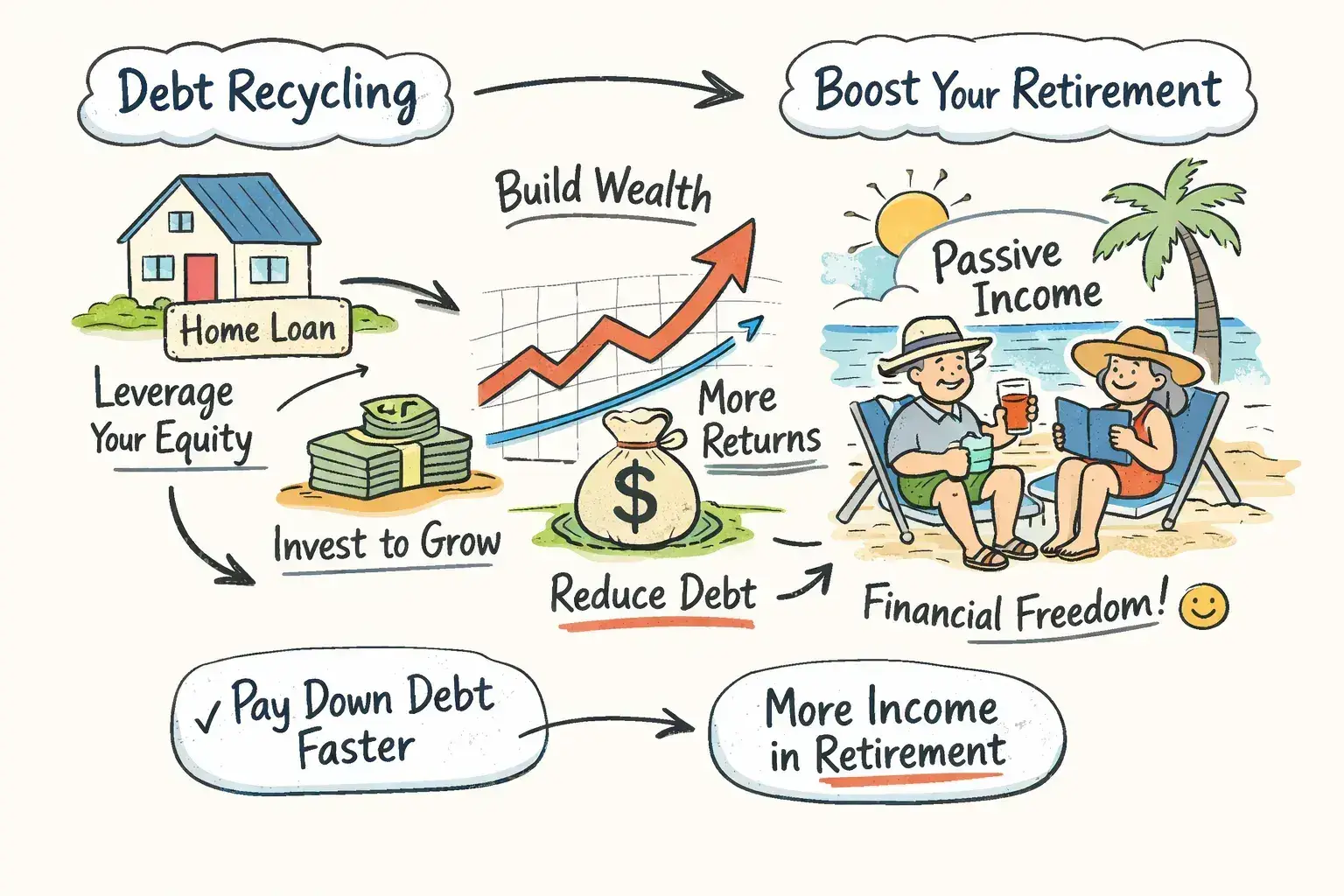
Debt recycling is a strategy that converts non-deductible mortgage debt into tax-deductible investment debt simultaneously accelerating your mortgage paydown and building an investment portfolio that generates retirement income. The mechanism is straightforward: you use surplus cash to make extra repayments on your home loan, then immediately redraw or re-borrow that same amount through a separate investment facility and invest it in income-producing assets. Over time, the non-deductible home loan shrinks while the income-producing investment portfolio grows. When structured correctly and documented rigorously, the interest on the investment loan may be tax-deductible under ATO rules on interest deductibility.
Debt recycling is not suitable for everyone, and the ATO has increased scrutiny of interest deductibility claims in recent years. This guide explains how the strategy works mechanically, the tax conditions that must be met for deductibility, the key risks, and a realistic worked example so you can assess whether it warrants deeper modelling for your situation.
Important: Debt recycling involves both financial planning and tax advice. The general information in this article does not constitute personal financial or tax advice. Before implementing any debt recycling arrangement, seek advice from a licensed financial adviser and a registered tax agent or tax adviser familiar with the ATO’s interest deductibility rules and the Part IVA general anti-avoidance provisions.
What Is Debt Recycling and How Does It Work?
The core idea of debt recycling is a “good debt/bad debt” conversion. Under Australian tax law, interest on debt used to produce assessable income (such as dividends, rent, or distributions from managed funds) is generally tax-deductible. Interest on debt used to purchase your principal home is not deductible. Debt recycling exploits this asymmetry by systematically replacing non-deductible home loan debt with deductible investment loan debt of the same amount dollar for dollar.
Here’s the repeatable cycle:
- Make extra repayments on your mortgage principal using surplus cash flow income above your regular living and loan expenses
- Redraw or re-borrow that repaid amount into a separate, clearly documented investment loan or facility
- Invest the re-borrowed funds in income-producing assets typically Australian shares, ETFs, or managed funds with regular dividend or distribution income
- Use investment income and ongoing surplus to repeat the cycle: make more extra repayments, redraw, reinvest
Each cycle converts a small amount of non-deductible home loan debt into deductible investment debt. Over years, the composition of your total debt shifts less home loan (not deductible), more investment loan (potentially deductible) while a growing investment portfolio generates income and capital growth alongside.
The Critical Condition: Tracing Must Be Airtight
The entire tax benefit of debt recycling depends on the ATO being able to trace the borrowed funds directly to income-producing investments. This is not optional documentation it is the legal basis for any interest deduction claim.
If funds are mixed (redrawn money goes into a shared account before being invested, or any portion is used for personal purposes), the deductibility claim is compromised or lost. The ATO’s guidance on “loans used to invest” requires a clear, unbroken nexus between the borrowed amount and the income-producing asset purchased with it.
Practical tracing requirements:
- Keep home loan and investment loan in completely separate facilities never let them share an account or offset pool
- Each redraw must go directly and immediately into purchasing an income-producing investment not into a transaction account first
- Maintain records of every transaction: date, amount redrawn, investment purchased, purchase price, and evidence of income produced
- Never use redrawn investment funds for personal expenditure even incidentally
- Document each cycle separately so any ATO audit can trace every dollar from redraw to investment

Worked Example: $500,000 Mortgage With $10,000 Annual Surplus
This example models the debt recycling strategy over 20 years for someone with a $500,000 owner-occupier mortgage at a 6.5% interest rate, applying $10,000 of annual surplus to the cycle. Investment returns are modelled at 6%, 7%, and 8% gross per year to show sensitivity. This is a simplified illustration it excludes fees, CGT on investment growth, tax on dividends, and assumes constant rates. Use it to understand the order of magnitude of the strategy, not as a precise financial projection.
| Scenario | Investment Return | Year 10: Mortgage Remaining | Year 10: Investment Portfolio | Year 20: Mortgage Remaining | Year 20: Investment Portfolio |
|---|---|---|---|---|---|
| Standard (no recycling) | N/A | ~$420,000 | $0 | ~$260,000 | $0 |
| Conservative | 6% p.a. | ~$280,000 | ~$125,000 | ~$110,000 | ~$360,000 |
| Base case | 7% p.a. | ~$280,000 | ~$138,000 | ~$110,000 | ~$410,000 |
| Optimistic | 8% p.a. | ~$280,000 | ~$153,000 | ~$110,000 | ~$468,000 |
Assumptions: $500,000 mortgage at 6.5%; $10,000 annual surplus applied to recycling; 30-year original term. Mortgage reduction is the same across all investment return scenarios because the same surplus is applied the difference is in investment portfolio value. Figures are rounded approximations. Excludes fees, income tax on investment returns, CGT, and any tax saving from interest deductibility. A tax adviser should model the after-tax figures for your specific situation.
The table reveals the key insight: with the same mortgage and the same annual surplus, debt recycling generates a meaningful investment portfolio by year 20 that a standard “just pay off the mortgage” approach does not. In the base case, a $410,000 investment portfolio alongside a substantially reduced mortgage represents a materially different retirement position than having only reduced the mortgage by the same amount.
Critically: if investment returns fall below the loan interest rate (6.5% in this example), the advantage deteriorates significantly. Stress-testing at 4% and 5% returns is essential before committing to this strategy the break-even point (where debt recycling outperforms simple mortgage repayment) is sensitive to the gap between investment returns and borrowing costs.
Tax Treatment: What Can Be Deducted and What Cannot
The tax case for debt recycling rests on the deductibility of investment loan interest under Section 8-1 of the Income Tax Assessment Act 1997. The ATO allows a deduction for interest on borrowed funds when:
- The borrowed funds are used to acquire an asset that produces assessable income (dividends, distributions, rent)
- The purpose of the borrowing is to produce income not capital gains alone
- The nexus between the borrowing and the income-producing investment can be clearly traced and documented
This means the type of investment matters. Shares in dividend-paying companies, dividend-focused ETFs, and managed funds that distribute income regularly are generally suitable. Growth-focused assets that produce no income (speculative shares, cryptocurrency) may not meet the income-producing test, and interest on borrowings to acquire them may not be deductible.
Part IVA: The General Anti-Avoidance Risk
Part IVA of the Income Tax Assessment Act 1936 is the general anti-avoidance provision that allows the ATO to cancel a tax benefit where the dominant purpose of an arrangement is to obtain a tax benefit rather than to genuinely earn income. Debt recycling is not inherently a Part IVA arrangement, the strategy has a legitimate commercial purpose (building an investment portfolio) independent of any tax benefit. However, arrangements that are structured primarily to maximise deductions rather than to genuinely invest for income could attract ATO scrutiny under Part IVA.
For larger or more complex debt recycling arrangements, many advisers recommend seeking a private ruling from the ATO before proceeding. This provides certainty about the deductibility position and documents the adviser’s tax analysis. The ATO’s current guidance on interest deductions should be reviewed in conjunction with your tax adviser.
Tax Impact: A Simplified Illustration
| Item | Example Figure | Tax Effect |
|---|---|---|
| Investment loan balance (Year 5) | $50,000 | — |
| Annual interest on investment loan (6.5%) | $3,250 | Potentially deductible at marginal rate |
| Tax saving (34.5% marginal rate) | ~$1,121/year | Reduces effective cost of investment borrowing |
| Effective net interest cost (after tax saving) | ~$2,129/year | Real borrowing cost after the deduction benefit |
| Dividend income from portfolio (4% yield on $50,000) | $2,000/year | Assessable income; plus potential franking credit offsets |
Illustrative only. Actual tax outcomes depend on your marginal rate, portfolio composition, franking credit position, and ATO acceptance of your interest deductibility claim. These figures are not financial or tax advice seek professional advice before proceeding.
Who Is Debt Recycling Suitable For?
Debt recycling is not a strategy for everyone. It involves leverage, tax complexity, and a multi-year commitment to disciplined documentation. The following framework helps assess suitability:
| Factor | Suitable | Less Suitable / Avoid |
|---|---|---|
| Home equity | Meaningful equity available to redraw against (20%+ LVR buffer) | Minimal equity; near LVR limits |
| Income and cash flow | Reliable income with consistent surplus after expenses and both loan repayments | Variable or uncertain income; tight cash flow after one loan payment |
| Liquidity needs | 3–6 month cash buffer maintained separately from recycling funds | Likely to need access to invested capital within 1–3 years |
| Investment time horizon | 10+ year horizon; can ride through market downturns without selling | Short-to-medium term; may need to sell investments during a downturn |
| Documentation discipline | Willing to maintain rigorous records; understand the tracing requirements | Unlikely to maintain strict separation of funds and records over years |
| Risk tolerance | Comfortable with investment volatility while carrying leverage | Would find leveraged investment losses severely stressful |
| Tax position | On a marginal rate of 32.5%+ where interest deductions have meaningful value | Low income; tax offset likely to be minimal or nil |
In our experience advising 500+ Australian families, the clients for whom debt recycling works best are typically aged 40–55, on salaries above $90,000, with a mortgage of $300,000–$700,000, a reliable surplus of $10,000–$30,000/year, and a genuine 10–15 year investment horizon before retirement. Below these parameters, the complexity often exceeds the benefit.
Debt Recycling vs Alternative Strategies: A Comparison
Before committing to debt recycling, it’s worth comparing it to the main alternatives:
| Strategy | What It Does | Key Advantage | Key Limitation |
|---|---|---|---|
| Debt recycling | Converts mortgage repayments into tax-deductible investment debt | Potentially tax-deductible interest; builds portfolio outside super | Complexity; leverage risk; requires rigorous tracing; tax specialist needed |
| Extra super contributions | Salary sacrifice or after-tax contributions grow inside super’s tax environment | 15% contributions tax; 0% earnings tax in pension phase; simple | Locked until preservation age; contribution caps apply ($30,000 concessional cap 2025–26) |
| Pay off mortgage early | Direct extra repayments to eliminate home loan faster | Guaranteed return equal to mortgage rate; simple; reduces risk | No investment portfolio built; no income stream; no tax benefit |
| Invest surplus outside super | Invest surplus directly in shares/ETFs without any debt | No leverage risk; simpler than debt recycling; no tracing required | No interest deduction; home loan not accelerated |
| Negative gearing (investment property) | Borrow to buy investment property where interest exceeds rental income | Tax deduction on loss; capital growth potential | Concentrated asset; illiquid; management burden; higher entry cost |
For most Australians approaching retirement, maximising concessional super contributions (up to the $30,000/year cap) delivers a simpler, lower-risk path to the same outcome more retirement assets because the tax saving (marginal rate vs 15% on contributions) and the 0% earnings tax in pension phase are both highly favourable without any leverage risk or ATO tracing complexity. For a detailed analysis of super contribution strategies, see our guide on whether extra super contributions before 60 are worth it.
Debt recycling is most compelling when: you’ve already maximised super contributions, you have mortgage debt with meaningful equity, and you want to build a portfolio outside super with a long horizon. It’s a complement to super strategy, not a replacement for it.
Loan Products and Lender Considerations
The operational viability of debt recycling depends heavily on your lender’s product features. Before implementing the strategy, confirm the following with your lender:
- Can the loan be split into two separate facilities? One for the owner-occupier home loan and one for investment draws? Clean separation of facilities is essential for tracing
- How does redraw work? Can you redraw specific amounts immediately after making extra repayments, and does the lender confirm the purpose of each redraw?
- Is interest charged monthly or can it be capitalised? For the investment facility, monthly interest charges affect cash flow planning
- What documentation will the lender provide to show each investment draw separately from personal loan balance? You’ll need this for ATO purposes
- What are the investment loan rates and fees? Investment property loans and margin loans carry higher rates than owner-occupier loans typically 0.3–0.6% higher at major lenders in 2026 market conditions. Small rate differences compound significantly over a 15-year strategy
- If using a margin loan on shares: what are the LVR triggers, margin call cure periods, and how are margin calls issued? Margin loans secured by shares carry the additional risk of forced selling during market downturns if LVR limits are breached
The ASIC Moneysmart guide on margin loans provides a useful overview of how margin lending works and its specific risks particularly relevant if considering a share-secured facility rather than a home equity redraw.
Key Risks to Understand Before You Start
Market Volatility and Leverage Risk
Debt recycling uses leverage borrowed money invested in markets. When markets fall, your investment portfolio loses value while the debt remains fixed. A 30% market fall on a $200,000 leveraged portfolio reduces the portfolio to $140,000, but the loan is still $200,000. Unlike super accumulation (where a market fall is painful but doesn’t trigger forced sales), leveraged investing can force you to sell at the worst time if cash flow deteriorates or (in the case of margin loans) if LVR limits are breached.
Interest Rate Risk
The entire arithmetic of debt recycling depends on investment returns exceeding borrowing costs net of tax. If investment returns are 6% and borrowing costs are 7% (net of deduction), the strategy is destroying value. Interest rates on investment loans are variable what works at 6.5% may not work at 8.5%. Stress-test the strategy at borrowing costs 1–2% above current rates and at investment returns 2% below your base case before committing.
Sequence of Returns Risk
As with all leveraged investing, sequence of returns matters enormously. A poor first 3–5 years particularly if combined with rising interest rates can permanently impair the strategy’s effectiveness. This is especially significant for retirees or near-retirees who may need to access the portfolio before full recovery. Maintaining a 3–6 month cash buffer in an offset account separate from all investment funds provides a serviceability buffer against short-term market or income disruptions.
ATO Tracing Failure
If documentation fails funds are mixed, personal purchases are made from the redrawn facility, or records are incomplete the ATO can deny the interest deduction for some or all of the investment loan. This converts what was intended to be deductible debt into effectively non-deductible debt, significantly changing the economics. Years of underpaid tax may then become payable with interest. This risk is entirely within your control through rigorous process discipline but it requires that discipline consistently, over many years.
Debt Recycling and Retirement Planning: How It Fits
Debt recycling builds an investment portfolio outside superannuation over the accumulation years. In retirement, this portfolio can provide income in two key ways:
- Dividend and distribution income a portfolio of Australian dividend-paying shares generates regular franked income that provides cash flow in retirement without requiring asset sales. Fully franked dividends from an Australian share portfolio are highly tax-efficient for retirees, who may be able to claim full franking credit refunds if their taxable income is low
- Capital drawdown the portfolio can be drawn down (sold progressively) to supplement super income, Age Pension, or other retirement income sources
Importantly, assets held outside super are treated differently from super for Age Pension purposes. Financial assets outside super are assessed under Services Australia’s deeming rules the same as super in pension phase. The deeming rate (0.25% on the first $62,600, 2.25% above, as of 2025–26) applies to the portfolio balance regardless of actual dividends received. This means a large investment portfolio built through debt recycling will affect Age Pension eligibility at 67 in the same way as a large super balance worth factoring into the retirement planning model.
For most Australians, the optimal approach is to use debt recycling as a complement to not a replacement for maximising super contributions. Super provides the most tax-efficient accumulation environment; the outside-super portfolio provides liquidity, flexibility, and an income stream that isn’t subject to the super access rules or minimum drawdown requirements. See our guide on whether to keep investing after retirement for how outside-super portfolios interact with retirement income strategy.
Frequently Asked Questions
Debt recycling is a strategy that converts non-deductible home loan debt into potentially tax-deductible investment debt. The mechanism is: make extra repayments on your mortgage principal, then immediately redraw or re-borrow that same amount into a separate investment loan facility and invest it in income-producing assets such as dividend shares or managed funds. Over time, your home loan reduces faster and an investment portfolio grows alongside it. The interest on the investment loan may be tax-deductible under the ATO’s interest deductibility rules, provided the borrowed funds are traceable directly to income-producing investments and strict documentation is maintained throughout.
Yes,debt recycling is a legal strategy in Australia when properly structured and documented. It relies on the general tax principle that interest on borrowed funds used to produce assessable income is deductible under Section 8-1 of the Income Tax Assessment Act 1997. The ATO has not prohibited debt recycling as a strategy. However, the strategy must be implemented with strict compliance: borrowed funds must be traceable to income-producing investments, funds must never be mixed with personal accounts, and the strategy must have a genuine commercial purpose beyond tax minimisation (to avoid the Part IVA general anti-avoidance provisions). Individual outcomes depend on specific circumstances and ATO scrutiny of interest deductibility has increased in recent years , professional tax advice is strongly recommended before implementing the strategy.
Potentially, yes but only if specific conditions are met. The ATO requires a clear, documentable nexus between the borrowed funds and the income-producing investments they are used to acquire. The investments must produce assessable income (dividends, distributions, rent) not just capital gains. The funds must not be mixed with personal accounts or used for personal purposes at any point. And the purpose of the arrangement must be genuinely to earn investment income, not primarily to obtain a tax benefit (which could attract Part IVA scrutiny). Given the ATO’s increased focus on interest deductibility claims, having a registered tax agent structure and document your debt recycling arrangement is not optional it’s essential. The ATO’s interest deductions guidance explains the requirements in full.
Income-producing investments that generate regular assessable income are most suitable: Australian shares with consistent dividend payments, broad-market or dividend-focused ETFs that make regular distributions, and unlisted managed funds that distribute income. These satisfy the ATO’s requirement that borrowed funds be used to produce assessable income. Investments that produce only capital gains speculative shares, growth-only ETFs with no distributions, cryptocurrency are generally unsuitable because the “produces assessable income” requirement may not be met, jeopardising the interest deduction. Investment property can also be used for debt recycling but involves additional complexity around the property purchase, management, and the interaction between the recycled debt and the direct mortgage on the investment property.
Using any portion of redrawn investment loan funds for personal expenses even inadvertently compromises the ATO tracing requirement and may result in the interest on the contaminated portion being denied as a deduction. In the worst case, the ATO may treat the entire investment loan as non-deductible if funds were commingled. This is why strict operational discipline is non-negotiable: the investment facility must be completely separate from any account you use for personal spending, and each redraw must go directly and immediately to purchase income-producing investments with no intermediate personal account step. If a mixing error occurs, speak to your tax adviser immediately there may be corrective steps available depending on the nature and extent of the mixing.
For most Australians, maximising concessional super contributions (salary sacrifice up to the $30,000/year cap in 2025–26) before considering debt recycling is the higher-priority strategy. Super contributions are taxed at 15% (versus up to 47% at marginal rate), investment earnings in pension phase are 0% (versus marginal rates outside super), and the process is simpler with no tracing complexity or ATO risk. Debt recycling becomes compelling as a complementary strategy when: you’ve already maximised super contributions, you have meaningful home equity and reliable surplus cash flow, you have a 10+ year investment horizon, and you’re seeking to build a liquidity source outside super’s preservation age constraints. Debt recycling and super maximisation are not mutually exclusiv the optimal approach often involves both, staged by priority. For the full super contributions analysis, see our guide on whether extra super contributions before 60 are worth it.
There’s no absolute minimum, but debt recycling involves fixed setup costs (loan restructuring, legal advice, tax specialist fees) that create a threshold below which the economics don’t justify the complexity. In practice, a minimum annual surplus of $5,000–$10,000 is often cited as the lower bound for debt recycling to be worth the setup and ongoing compliance cost. Below this level, the tax saving from deductible interest is relatively small and the simpler alternatives (extra super contributions, direct investing without leverage) likely achieve similar outcomes with less risk and complexity. At $10,000–$30,000+ annual surplus with a 15+ year horizon, the compounding effect of debt recycling becomes more material and the strategy is more likely to justify its complexity.
There is no single definitive debt recycling calculator but you can build a reliable estimate in minutes using free tools. The key inputs are: your current mortgage balance, your loan interest rate, your reliable annual surplus, and an investment return assumption (use 5%, 7%, and 9% to bracket the outcome).
A practical four-step calculation:
- Model your mortgage paydown schedule use the ASIC Moneysmart mortgage calculator to show how your balance reduces over time both with and without extra repayments. This establishes your baseline.
- Model investment portfolio growth use the Moneysmart compound interest calculator to model your annual surplus invested at 5%, 7%, and 9% over 10 and 20 years. This gives you the portfolio side of the equation.
- Estimate the interest deduction benefit multiply your expected annual investment loan balance by your loan rate, then by your marginal tax rate: loan balance × interest rate × marginal rate = annual tax saving. For example: $50,000 × 6.5% × 34.5% = approximately $1,121/year in tax saved.
- Compare total net worth at year 10 and year 20 under two scenarios: (a) with debt recycling, and (b) the same surplus applied to simple mortgage repayment. The difference is the debt recycling premium the additional wealth created by the strategy after costs.
For a complete model that incorporates CGT on investment growth, income tax on dividends, and the Age Pension means test interaction, a financial adviser’s modelling software is far more accurate than a DIY spreadsheet particularly for those within 10 years of retirement where the timing of asset disposals significantly affects the net outcome.
Next Steps: How to Assess Whether Debt Recycling Is Right for You
If you’re interested in exploring debt recycling for your retirement strategy, here’s a practical sequence:
- Run a rough scenario with your numbers. What is your current mortgage balance and interest rate? What reliable annual surplus do you have after all expenses and minimum loan repayments? Model the strategy at 5%, 7%, and 9% investment returns over 10 and 20 years. Compare with the same surplus applied directly to mortgage repayment and to super contributions.
- Check your loan’s suitability. Contact your lender and ask the specific operational questions from the “Loan Products” section above particularly whether clean facility splitting and tracing-compliant documentation are available.
- Consult a registered tax agent before any implementation. Get in writing how your proposed investment choices and documentation approach satisfy the ATO’s interest deductibility requirements. For larger arrangements, ask about the appropriateness of seeking a private ruling from the ATO.
- Model the full after-tax position with a financial adviser who can integrate debt recycling with your super strategy, Age Pension interaction, and retirement income plan not just the pre-tax numbers.
At Wealthlab, we help Australians model debt recycling as part of a comprehensive retirement income strategy integrating it with super contributions, account-based pension planning, and Age Pension optimisation to ensure it adds genuine value rather than just tax complexity. Book a free consultation today to run a tailored debt recycling scenario with your actual numbers.